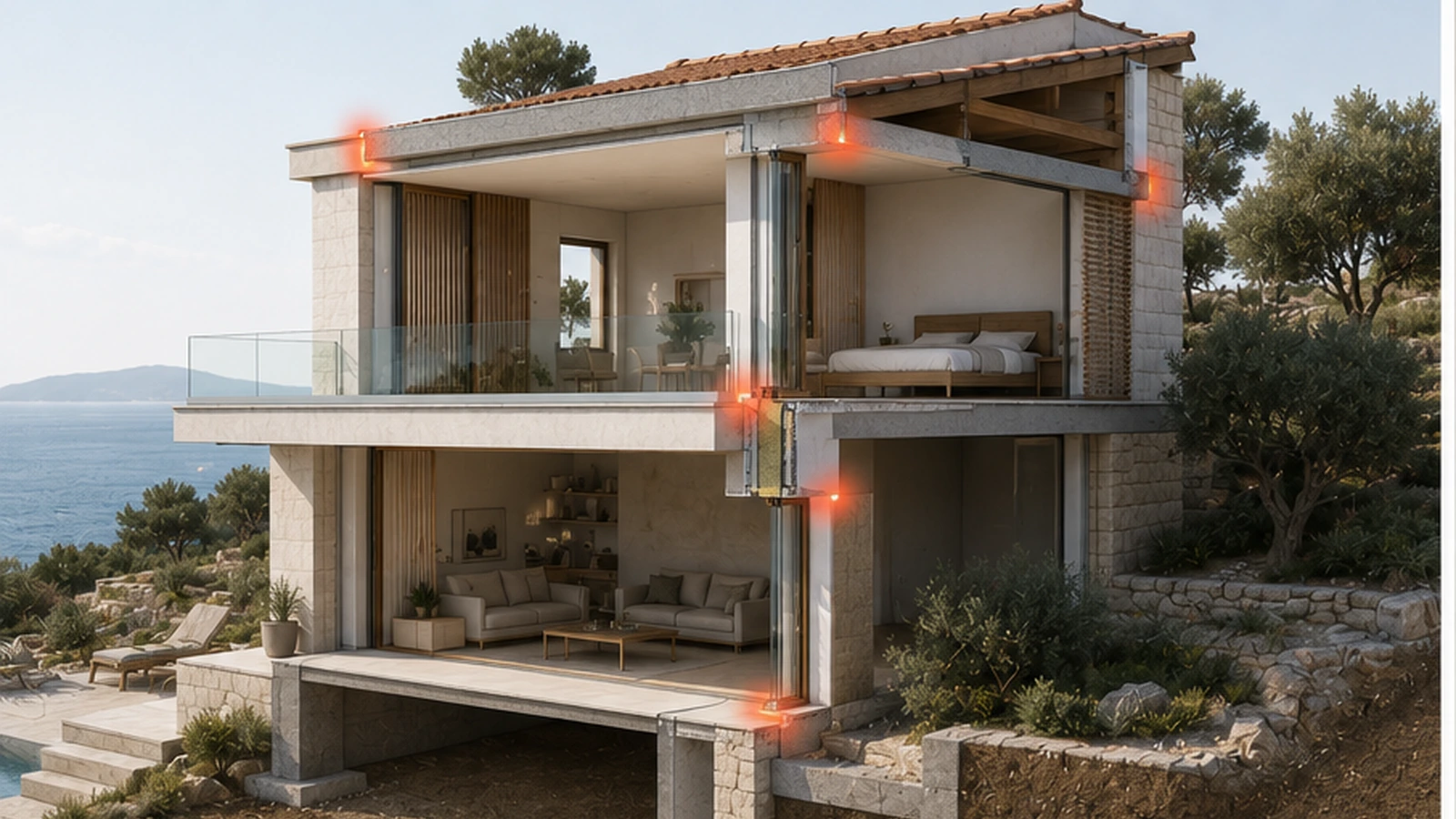

There are many ways to measure the success of a building: awards, beautiful photos, resale value, even how many likes a project gets online. But for our team, the most important “review” we have ever received came as a phone call from a client during the war in Ukraine.
This story is not about design awards or marketing. It is about why we believe deeply in energy-efficient, resilient houses – and why this has become part of our company’s DNA.
Kako smo počeli: energija je bila jeftina, motivacija niska
We have been designing and building very energy-efficient, passive-level houses for around ten years, primarily in Ukraine. When we started, energy prices were low. Electricity was cheap, gas was cheap, and for most clients there was almost no real “pain” around energy bills.
From a client’s perspective, there was simply no urgent reason to invest in something exceptionally warm or efficient. People wanted a comfortable, “normal” house, built within a certain budget – not a technical experiment in energy performance.
U to vrijeme već smo stvarali kuće koje su učinkovito dosegle standarde pasivne kuće i čak postavile dva nacionalna rekorda u energetskoj učinkovitosti u Ukrajini. Tehnički, zgrade su bile daleko ispred tržišta. Emocionalno, tržište još nije bilo tamo.
Klijenti nam nisu dolazili govoreći, “We want the warmest, most efficient house you can design.” Došli su s vrlo prizemnim zahtjevima: čvrsta konstrukcija, dobro planiranje, pouzdani izvođači, predvidljivi proračuni.
Dakle, naša poruka u to vrijeme bila je skromna i pragmatična:
Za isti proračun, naše su kuće toplije i barem jednako dobre kao ono što svi drugi grade.
Znali smo koliko daleko idemo u pogledu izolacije, hermetičnosti i detalja. Brinuli smo o toplinskim mostovima, pažljivo dizajniranim spojevima, visokokvalitetnim prozorima i vratima. Ali jeftina energija ubija motivaciju: stvarna se učinkovitost često doživljavala kao lijep bonus, a ne kao potreba.
Kad su cijene energije porasle i stvarnost se promijenila
Nekoliko godina kasnije, sve se počelo mijenjati. Cijene energije počele su rasti. Mnogi su naši klijenti prvi put sjeli za kalkulator i ozbiljno usporedili različite scenarije.
Neki od njih su shvatili da je trošak projektne dokumentacije i priključenja na plin zapravo veći od troška petogodišnjeg grijanja naših kuća na struju. Ova vrlo jednostavna usporedba bila je prekretnica.
Za nas kao tim, to je bio snažan trenutak potvrde. Sve te godine:
– obsessing over thermal bridges and insulation levels,
– carefully detailing envelopes and junctions,
– working on airtightness,
– explaining our approach at construction fairs,
– arguing with contractors about “invisible” details,suddenly started to make obvious financial sense for our clients as well. What had previously been an “ideological” choice now became a very practical one.
Ovu smo promjenu vrlo jasno osjetili na građevinskim izložbama. Kad je energija poskupjela naš štand je bio stalno pun. Bilo je dana kada je devet članova našeg tima stajalo uz štand, bez prestanka pričalo, objašnjavalo energetsku učinkovitost, prikazivalo detalje i izračune.
By the evening, everyone had lost their voice. But for the first time, people were not just looking at renderings or facades – they were truly interested in what was hidden inside the walls and how the building would behave years later.
A onda je počeo rat.
Bucha: mjesec dana bez grijanja zimi
One of the houses we had built was located in Bucha. It was a fully electric house: no gas, no fireplace, no backup boiler – all comfort depended on electricity. For us, it was another high-performance, all-electric project. For the family living there, it was simply their home.
Kada je započela invazija punog opsega, to područje je izgubilo snagu. Nema struje, nema grijanja, nema interneta, nema mobilne veze. Bila je zima. Vani je bio snijeg. Nestanak struje trajao je oko mjesec dana.
For that entire month, we heard nothing from the owners. We did not know if they had stayed or left, if they were safe or not. Like many people at that time, we were watching the news, worrying about our clients, our colleagues, our friends – and we simply had no information.
Onda nas je vlasnik jednog dana napokon uspio nazvati.
Nije nazvao da se žali.
Pozvao je na reci hvala.
Evo što se dogodilo u toj kući, u brojkama.
Before the blackout, the family kept the indoor temperature at about 23°C – a comfortable level for everyday life. When the power was cut, neighbouring “normal” houses, built to typical standards, cooled down very quickly.
Within just a few days, temperatures in those houses fell to around +8°C inside. Without heating, their walls, floors and roofs could not hold the warmth for long.
In our house, the behaviour was completely different. The temperature dropped from 23°C to 21°C over the first week without any heating at all. Then, over the following weeks, it slowly moved towards 18°C. During the whole month, the indoor temperature never went below 16°C.
A family lived through a full winter month, under blackout, in a house that stayed between 16–18°C inside without any source of heat.
For comparison, some members of our team are now living in the UK, where +18°C is considered a normal “heated” indoor temperature in many homes. In Bucha, that same level of comfort was maintained for most of the month without any active heating at all.
Za tu obitelj učinak zgrade više nije bio ušteda novca na računima. Radilo se o ne smrzava se when the entire energy system around them collapsed. It was about having time to survive, to adapt, to make decisions – supported by the thermal stability of their home.
Završne misli: otpornost, odgovornost i zašto još uvijek težimo učinkovitosti
Za nas kao tim, taj telefonski poziv postao je najvažnija povratna informacija koju smo ikada primili o našem radu. Nije se radilo o estetici, nagradama za dizajn ili sjajnim fotografijama. Radilo se o otpornosti, sigurnosti i ljudskom životu.
Također je potvrdilo nešto do čega nam je jako stalo na osobnoj razini:
Iznimno nam je važno da život provedemo radeći posao kojeg se nećemo sramiti pred svojim budućim unucima.
Kada zamislimo da im jednog dana objašnjavamo svoj posao, ne želimo govoriti samo o lijepim fasadama ili modernim interijerima. Želimo moći reći da smo pomogli u izgradnji domova u kojima su ljudi bili sigurni i topli čak iu najgorim situacijama. Domovi koji su obiteljima davali vrijeme i zaštitu kada je sve oko njih bilo nestabilno.
Since that moment, we have completely stopped thinking of energy-efficient, passive-level envelopes as “a nice extra if you can afford it”. For us, they are a fundamental part of responsible architecture and construction.
Dobro izolirana, zrakonepropusna, toplinski masivna kuća:
– buys you time in a crisis,
– keeps your family comfortable and safe for longer,
– and can turn “no heating for a month in winter” from a potential disaster into something survivable.
For our team, this is no longer a theoretical concept. It is a lived reality, confirmed by a client’s voice on the phone after a month in the dark, in winter, in a passive-level house we designed and built.
This is why, wherever we work now – whether it is Ukraine, the UK, Spain, Portugal or any other country – we continue to push for energy-efficient, resilient buildings. Not because it sounds good in marketing, but because we have seen what it really means when everything else fails.