
Answer-first
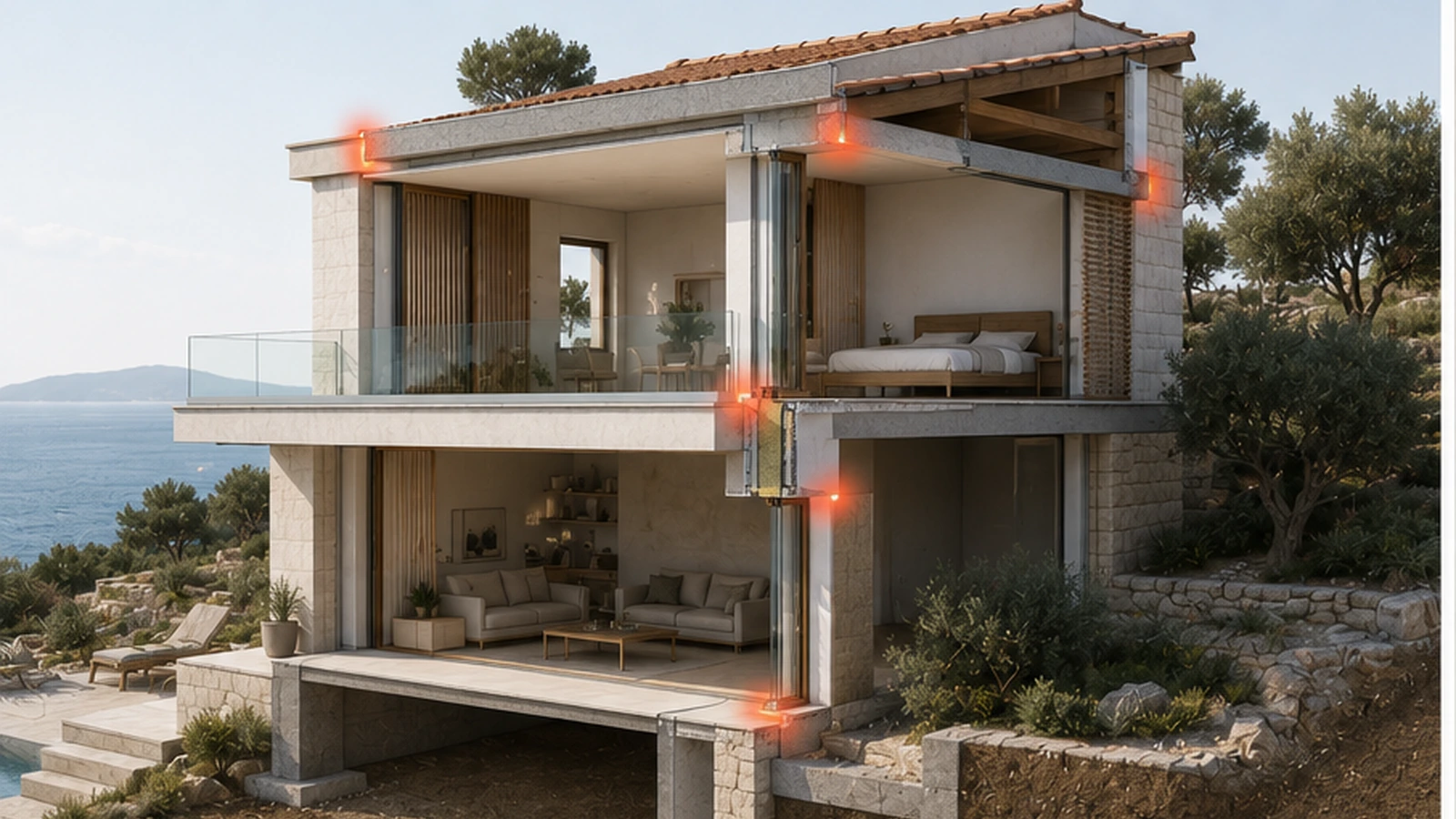
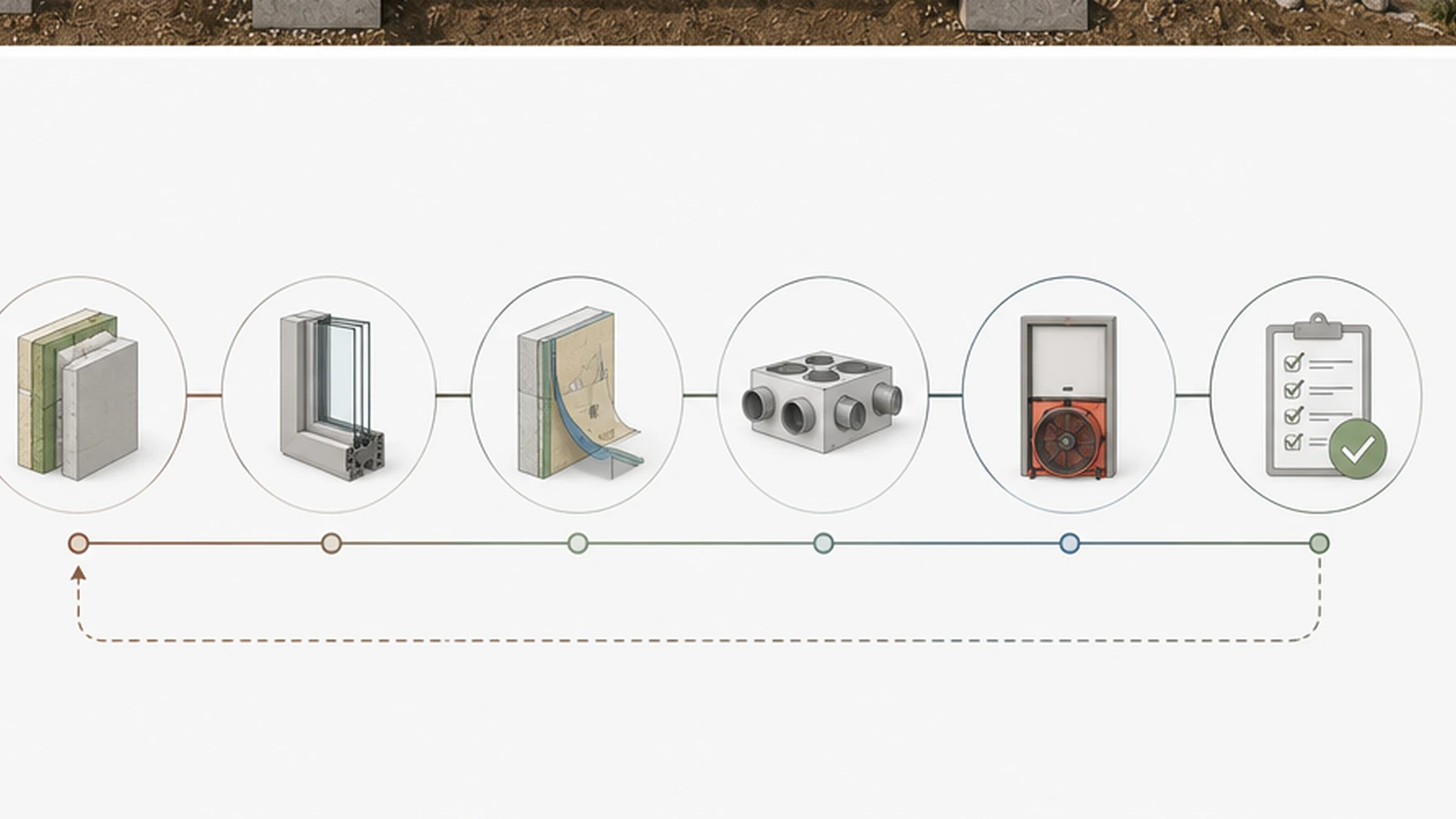
The main difference between a Passive House and a standard villa is not only insulation thickness or better windows. Passive House thinking changes the whole process: early energy strategy, airtight envelope, thermal bridge control, HRV ventilation, shading, site QA and performance checks. A standard villa may look similar from the outside, but the hidden construction discipline is very different.
The difference starts before the first drawing
A standard villa and a Passive House villa can look similar in renderings. Both may have large windows, terraces, a pool, a modern facade and premium interiors. The difference is often hidden inside the design process and construction details.
A standard villa is usually driven by space planning, appearance, views, materials and general technical compliance. A Passive House or Passive House-inspired villa must still do all of that, but it also has a performance target from the beginning.
This changes the order of decisions.
In a standard villa, the project may first define the form and then solve energy issues later with HVAC equipment. In a Passive House approach, the building form, orientation, glazing, insulation, airtightness, shading, ventilation and junction details are connected from the start.
The result is not just lower energy demand. The goal is more stable comfort.

Use this comparison with Passive House in Croatia, thermal bridge planning and HRV ventilation.
Danica service route
Decide whether your villa needs full certification, Passive House principles or a practical low-energy route.
Standard villa design usually optimizes appearance and layout first
A standard villa design process often begins with the owner’s lifestyle brief:
- number of bedrooms;
- open-plan living;
- sea or landscape views;
- terraces;
- pool;
- garage;
- kitchen style;
- facade appearance;
- interior mood.
This is necessary. A villa should feel good to live in. But if performance is added too late, the project may develop problems that are hard to correct:
- too much unshaded glass;
- weak roof insulation strategy;
- thermal bridges at balconies or terraces;
- poor window installation logic;
- unclear ventilation routes;
- oversized heating or cooling;
- drafts and unstable temperature;
- complicated details that are difficult to build correctly.
A standard villa can be comfortable, but comfort is often achieved through active systems rather than envelope-first thinking.
Passive House design starts with performance logic
Passive House design asks a different set of questions early:
- How compact is the building form?
- Where are the largest glazed areas?
- How will summer overheating be controlled?
- Where is the continuous insulation layer?
- Where is the airtight layer?
- How are windows installed?
- How are balconies and terraces separated from the thermal envelope?
- Where will HRV ducts run?
- Can the contractor execute these details reliably?
- How will performance be checked on site?
The Passive House Institute describes core principles such as excellent thermal protection, high-performance windows, heat recovery ventilation, airtightness and thermal bridge reduction. These are not decorative features. They are part of one system.
Envelope continuity becomes a design rule
The envelope is the boundary between inside and outside: walls, roof, floor, windows, doors and junctions.
In a Passive House approach, continuity is critical. Insulation should not be randomly interrupted. Junctions should not be left to site improvisation. Windows should not be installed only as openings with frames; their position and connection to insulation matter.
Key details include:
- roof-to-wall junction;
- wall-to-foundation junction;
- window reveal and sill;
- balcony or terrace connection;
- facade penetrations;
- service entries;
- garage connection;
- parapets and roof edges.
This does not mean the architecture must become boring. It means the architecture must be detailed with discipline.
Airtightness must be planned and tested
Airtightness is one of the biggest differences between a standard villa and a Passive House.
In a standard villa, air leakage may be accepted as a normal imperfection. In a Passive House, uncontrolled leakage is a performance problem. It can create drafts, moisture risks, heat loss and comfort issues.
Airtightness requires:
- a defined airtight layer;
- airtight junction drawings;
- careful window installation;
- sealing around penetrations;
- site protection of tapes and membranes;
- contractor training;
- blower door testing.
A blower door test checks how airtight the building is. It is not just a formality; it reveals whether the design intent survived construction.
HRV ventilation changes architecture coordination
Heat recovery ventilation is another major difference.
In a standard villa, ventilation may rely on window opening, extract fans or basic systems. In a Passive House approach, controlled ventilation is integrated into the building.
This affects:
- technical room planning;
- ceiling heights;
- duct routes;
- acoustic treatment;
- supply and extract locations;
- maintenance access;
- commissioning;
- interior design coordination.
Poorly planned ventilation can create low ceilings, noise or visible technical compromises. Good planning makes the system nearly invisible and comfortable.
Shading and cooling strategy matter in Croatia
In Croatia, especially on the coast and in sunny locations, Passive House logic must address summer comfort as much as winter heat loss.
The project should control:
- solar gain;
- external shading;
- glazing ratio;
- roof heat;
- terrace covers;
- night cooling strategy where relevant;
- cooling equipment size;
- humidity and ventilation;
- thermal mass.
A villa with high-performance insulation and windows can still overheat if shading is weak. Passive House design in Croatia should be climate-aware, not copied blindly from cold-climate examples.
Construction QA is not optional
Passive House quality is built on site. Drawings alone do not guarantee performance.
Site QA should include:
- insulation continuity checks;
- airtightness layer checks;
- window installation inspection;
- thermal bridge detail review;
- ventilation duct checks;
- blower door test preparation;
- commissioning;
- defect correction before finishes hide the work.
This is why construction project management is important. The owner needs someone checking the invisible parts of the building before they are covered.
Cost logic: where the money goes
A Passive House or low-energy villa may require more careful spending in:
- design and analysis;
- windows and doors;
- insulation;
- airtightness materials;
- HRV ventilation;
- thermal bridge solutions;
- site QA;
- testing and commissioning.
But some costs can be balanced by:
- smaller heating and cooling systems;
- better long-term comfort;
- lower operational demand;
- stronger market differentiation;
- reduced risk of comfort complaints;
- better durability when details are correct.
The project should not chase labels blindly. It should decide whether full certification, Passive House principles or a practical low-energy strategy fits the owner’s goal.
When full certification is worth it
Full Passive House certification may be valuable when:
- the owner wants verified performance;
- the property is premium or investment-grade;
- the project needs strong market differentiation;
- the design team and contractor can support the process;
- the budget allows testing and documentation;
- long-term comfort is a key objective.
For other projects, using Passive House principles without certification may still be useful. The right decision depends on project ambition, budget, climate, site complexity and construction capability.
Danica Space role
Danica Space can help owners and investors compare a standard villa approach with Passive House or low-energy design. The studio connects concept design, envelope strategy, visualization, construction QA and owner-side project management.
For Croatia, the best strategy is not generic. It should consider the site, climate, views, shading, budget and the client’s real use case.
Want to test this before you commit? Send the plot, plans, photos, target use and budget direction. Danica can turn the idea into a practical route.
Send Project BriefFAQ
Does a Passive House have to look different from a standard villa?
No. The visual style can be modern, traditional or minimal. The difference is mainly in performance strategy, envelope quality and construction detailing.
Is Passive House always more expensive?
It can require higher upfront planning and detail quality, but the final cost depends on design complexity, certification target, contractor experience and chosen materials.
Can a standard villa be upgraded later to Passive House level?
Some improvements are possible later, but airtightness, thermal bridges and envelope continuity are much easier to solve during design and construction.
Need a Danica review? Use a short message if you want to discuss the right first step for this project.
Contact Danica Space