
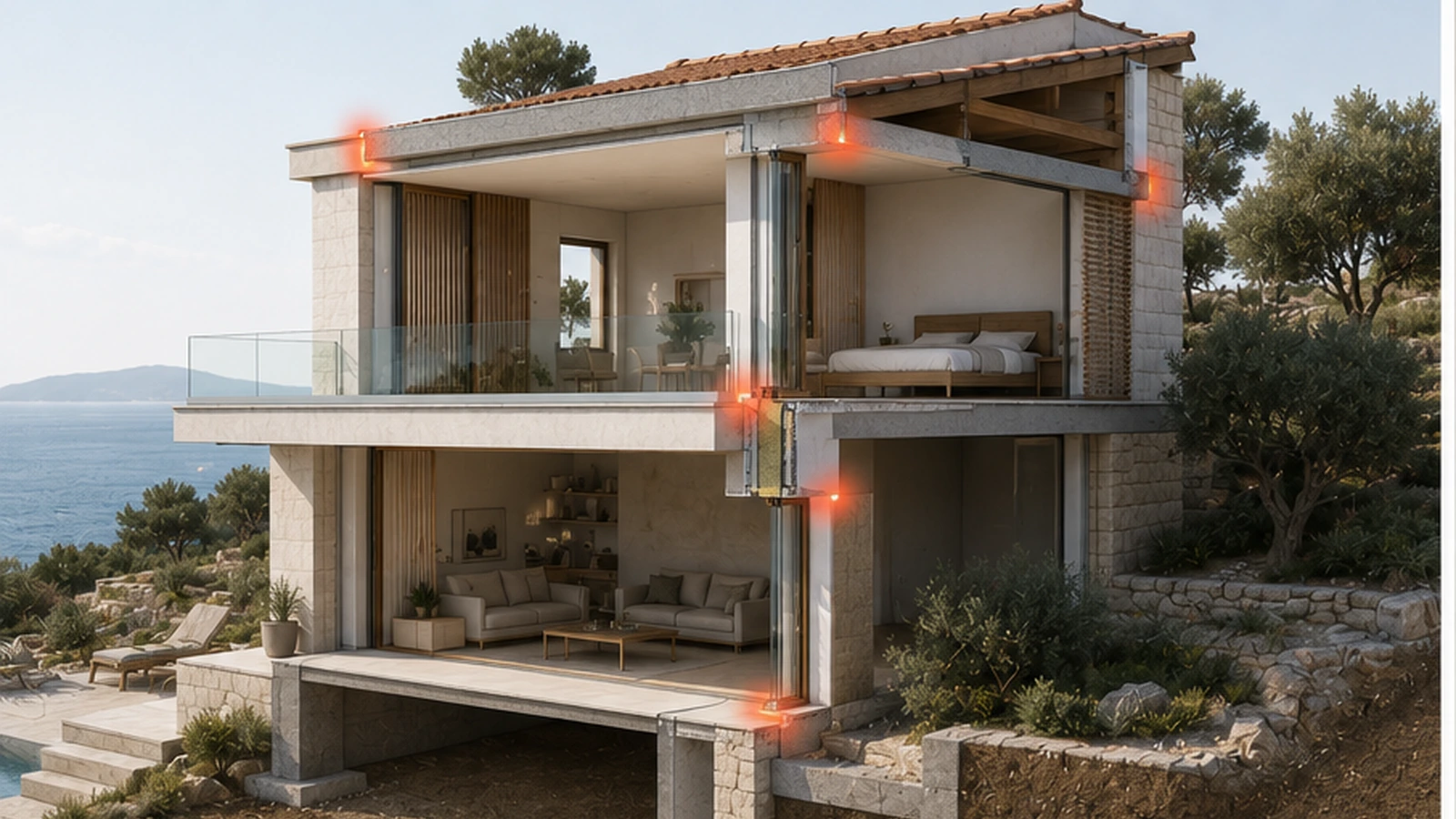
Answer-first
A thermal bridge is a weak point in the building envelope where heat moves more easily than through the surrounding construction. In Mediterranean homes, thermal bridges are not only a winter problem. They can affect cooling demand, surface temperature, condensation risk, indoor comfort and long-term durability. They should be addressed during design, not after construction.
What a thermal bridge is
A building envelope is supposed to separate indoor comfort from outdoor climate. Walls, roof, floor, windows and doors all play a role. A thermal bridge appears where this separation becomes weaker.
It can happen because of:
- a structural element crossing the insulation layer;
- a break in insulation continuity;
- poor window installation;
- uninsulated balcony slabs;
- foundation edges;
- roof-wall junctions;
- metal elements;
- service penetrations;
- badly resolved facade details.
A thermal bridge is not always visible. It may be hidden inside the construction. But its effects can become visible through cold surfaces, condensation, mold, discomfort or higher energy use.
For the broader low-energy strategy, start with Passive House in Croatia.
Danica service route
Review envelope details early so comfort and energy performance are not lost at windows, slabs and roof edges.
Why thermal bridges matter in Croatia and Mediterranean climates
In cold climates, thermal bridges are usually discussed as heat-loss points. In Mediterranean and Adriatic climates, the issue is broader.
Thermal bridges may affect:
- winter heat loss;
- summer heat gain;
- cooling demand;
- local surface comfort;
- condensation in shoulder seasons;
- indoor humidity problems;
- durability of finishes;
- perceived quality.
A coastal home may not have extreme winter conditions, but it can still have moisture, wind, temperature differences and cooling loads. Weak envelope details can make the home feel less stable and less premium.
Common thermal bridge locations
The most common thermal bridge zones are:
| Location | Why it matters |
|---|---|
| Window junctions | Poor installation can create cold or hot spots and air leaks |
| Balcony slabs | Concrete can bypass insulation and carry heat through the envelope |
| Terrace connections | Waterproofing and insulation continuity are often difficult |
| Foundation edges | Ground connection can create heat loss and surface discomfort |
| Roof-wall junctions | Insulation continuity is often broken at parapets and eaves |
| Structural columns | Columns may interrupt wall insulation |
| Metal brackets | Small elements can create repeated thermal weaknesses |
| Service penetrations | Pipes, vents and cables can break airtight and thermal layers |
The earlier these points are reviewed, the easier they are to solve.
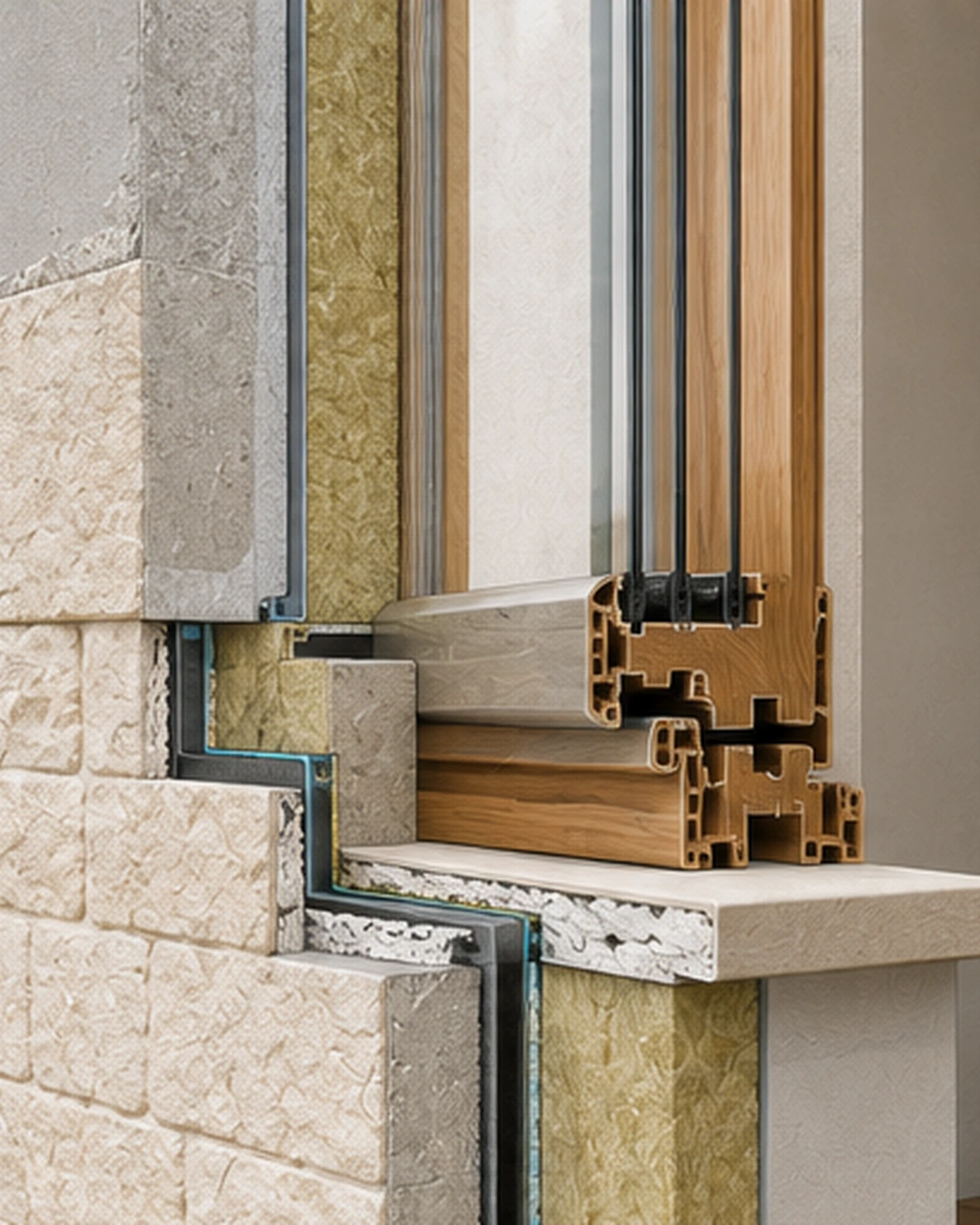
Windows and external openings
Windows are one of the most important parts of the thermal envelope. Even a high-performance window can underperform if installed badly.
Important details include:
- window position in the wall;
- insulation overlap around the frame;
- airtight tape or sealing;
- external sill detail;
- shading integration;
- water drainage;
- connection to facade finish;
- interior reveal treatment.
In many homes, the window itself is not the only problem. The junction around the window is the weak point.
For high-comfort buildings, the window detail should be designed, not improvised by the installer.
Balconies, terraces and concrete slabs
Balconies and terraces are among the most difficult thermal bridge areas.
A concrete slab that extends from inside to outside can bypass insulation. This creates a path for heat flow and can lower the interior surface temperature near the connection.
In Mediterranean homes, terraces are essential for lifestyle value. The goal is not to avoid them. The goal is to design them correctly.
Possible strategies include:
- thermal break elements;
- separated terrace structures;
- continuous external insulation;
- careful waterproofing layers;
- adjusted slab design;
- exterior shading and drainage coordination.
Terrace design should connect architecture, structure, waterproofing and energy logic.

Foundations and ground connections
The bottom of the building is often ignored visually, but it is technically important.
Foundation thermal bridges can appear at:
- slab edges;
- basement walls;
- ground-floor perimeter;
- garage connections;
- retaining wall interfaces;
- exterior stairs or platforms.
These zones can affect floor comfort, moisture risk and energy performance. For hillside villas, ground connections and retaining structures require even more attention.
Roof and parapet details
Roof edges, parapets and terrace roofs are frequent weak points.
The detail must solve several things at once:
- insulation continuity;
- waterproofing;
- drainage;
- facade finish;
- structural movement;
- parapet capping;
- airtightness if relevant;
- maintenance.
A minimal modern roof edge may look simple in renderings, but it can be technically demanding. If the detail is not resolved, the building may suffer from leaks, cracks, thermal bridges or poor durability.
Thermal bridges in renovations
Renovations are harder than new buildings because existing structure limits what can be done.
Common renovation challenges include:
- old balcony slabs;
- uninsulated walls;
- internal insulation risk;
- poor window replacement details;
- existing concrete beams and columns;
- limited facade access;
- neighbor or building rules;
- unknown hidden defects.
Not every renovation can become thermal-bridge-free. But many projects can improve comfort by identifying the most important weaknesses and addressing them realistically.
How to reduce risk
Thermal bridge risk can be reduced through:
- early envelope strategy;
- detail drawings;
- window installation planning;
- insulation continuity review;
- structure and architecture coordination;
- site checks before closing works;
- blower door testing where relevant;
- thermal imaging in diagnostics or QA where useful.
The key is coordination. Thermal bridges are not solved only by choosing thicker insulation. They are solved by continuous thinking across design and construction.
Danica Space role
Danica Space can help owners and developers integrate thermal bridge thinking into concept design, Passive House strategy, renovation planning and construction management. The studio focuses on comfort, buildability and detail quality rather than treating energy efficiency as a slogan.
For Croatian homes, especially villas, renovations and coastal properties, this detail-led approach can improve both comfort and long-term value.
Want to test this before you commit? Send the plot, plans, photos, target use and budget direction. Danica can turn the idea into a practical route.
Send Project BriefFAQ
Are thermal bridges only a problem in winter?
No. They can also affect summer heat gain, cooling demand, condensation risk and surface comfort.
Can thermal bridges be fixed after construction?
Sometimes, but it is usually more expensive and less effective than solving them during design and construction.
Does more insulation automatically remove thermal bridges?
No. Insulation thickness helps, but continuity and junction details are just as important.
Need a Danica review? Use a short message if you want to discuss the right first step for this project.
Contact Danica Space

