

Answer-first
Concept design should come before permit drawings because it is the stage where the owner can still change the idea without paying for a fully developed technical package. It tests layout, massing, access, views, budget direction, construction logic and planning constraints before the project becomes expensive to correct. For private villas, renovations and investment properties in Croatia, concept design is often the difference between a beautiful idea and a buildable project.
What concept design actually solves
Many owners think of architecture as a sequence that starts with an architect preparing permit drawings. In reality, the most important design and financial decisions often happen before the permit package.
Concept and schematic design is the early architectural stage where the project direction is tested before heavy documentation begins. It is not just a sketch. A useful concept design asks where the building sits, where the views are, how the car enters the site, how the house connects to terraces, which layout feels natural, how many levels make sense, what construction logic is implied and whether the idea matches the budget.
For a renovation, concept design can answer different questions: which walls should stay, what circulation should change, where the kitchen should move, how the apartment can feel larger, whether the bathroom position is realistic and whether the final value justifies the intervention.
The value of concept design is that it keeps decisions flexible while they are still relatively inexpensive.

Why going directly to permit drawings can be risky
Permit documentation is important, but it should not be used to discover the basic idea. If the owner starts formal documentation before the concept is resolved, the project may become locked into weak assumptions.
Common risks include a house positioned poorly on the plot, missed view potential, inefficient layout, terraces that do not connect naturally to interiors, too much circulation, unrealistic retaining walls or access logic, budget too high for the intended property value and late redesign after technical documents have already started.
Croatia has formal building permit procedures, and applications may be submitted electronically or through the competent administrative body depending on location and project type. The ePermit system is intended to support uniform permit procedures across the country. This makes early clarity even more important: the owner should not enter formal stages with an unresolved concept.
The decisions that belong before permit stage
Before permit drawings, the owner should ideally resolve building position, volume and massing, main layout, access and parking, outdoor spaces, budget direction, construction logic and visual identity.
These decisions affect views, privacy, terrace quality, construction cost, planning fit, daily use, resale logic and how easily the project can be built. A permit package should develop a chosen direction, not invent it from zero.
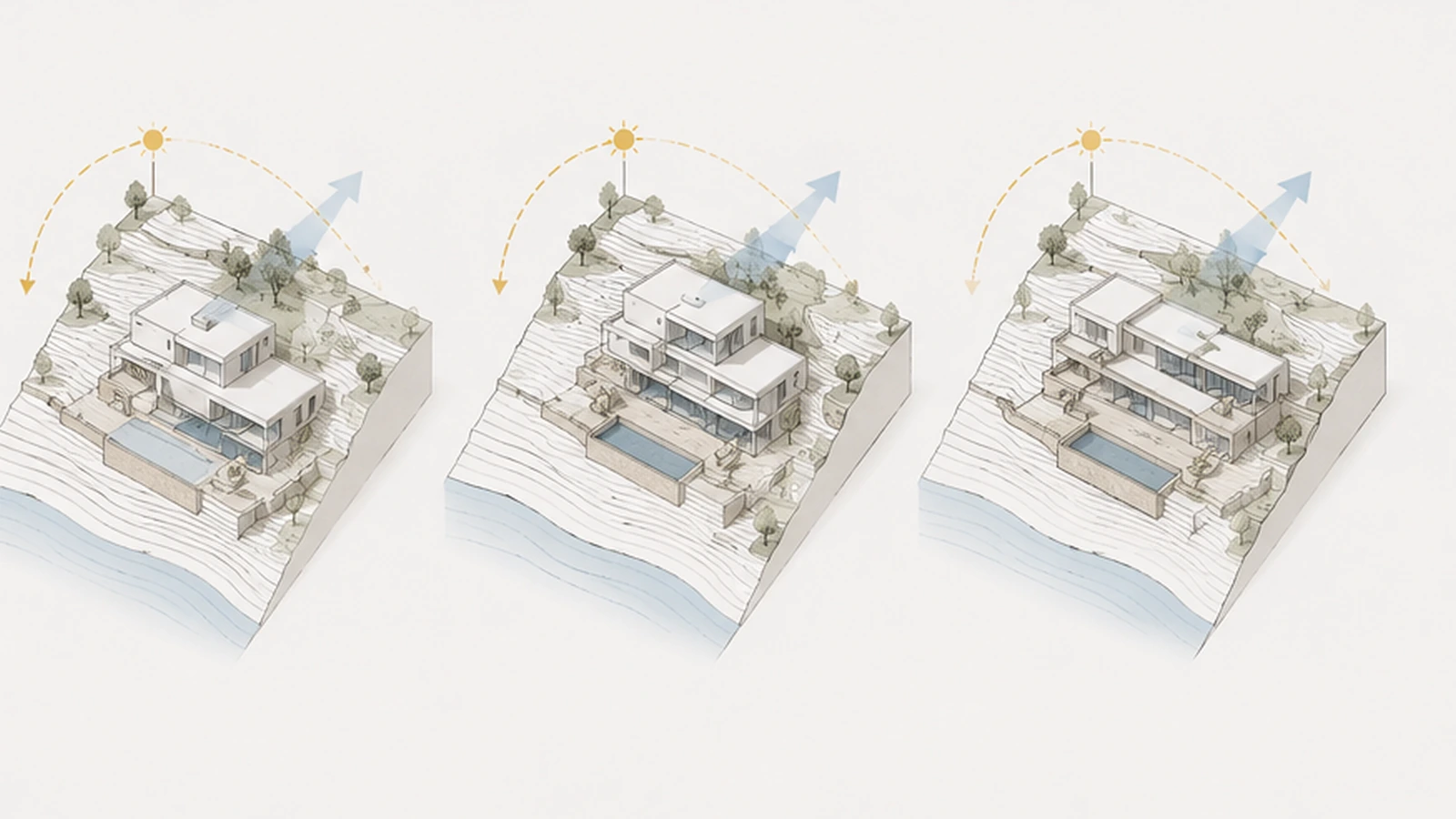
Concept design for a new villa
For a new villa, concept design should begin with the plot. The plot is not an empty rectangle; it is a system of views, slopes, neighboring buildings, access, sun, wind, privacy, technical connections and planning rules.
A good villa concept should test how the house is approached, whether the entrance has a clear experience, where the living area should face, how bedrooms are separated from social areas, how outdoor living works, whether the pool connects to the main living space, how parking is hidden or integrated, how the building sits on slope and whether the volume is too large or too fragmented.
For coastal or hillside sites, the villa should not only have a view. The view should be structured: arrival, living room, terrace, pool, master bedroom and guest areas should all have a deliberate relationship to the landscape. For land purchases, this connects directly to plot feasibility in Croatia.
Concept design for renovation
In renovation, concept design is often even more valuable because existing conditions create invisible constraints. Before technical drawings, the owner should understand what can realistically be changed, what should not be changed, which walls may be structural, where wet zones can move, how ceiling height limits lighting and AC, which defects may affect the budget and whether the investment is proportional to the final value.
For apartment renovations, concept design can test multiple layout options before a contractor is asked to price anything. This prevents the owner from pricing a weak version of the project. After purchase, the same sequence is useful: an after-purchase architecture review can collect documents, site notes and owner goals before concept work begins.
Need options before documentation? Send the site, plans, photos, target budget and project goal before the permit route or contractor scope is locked.
Send Project BriefConcept design for investors and developers
For investors, concept design is not only an aesthetic stage. It is a commercial filter. A developer or investor needs to know whether the project has clear product positioning, enough saleable or rentable quality, strong arrival experience, efficient layouts, good room ratios, attractive terraces and outdoor space, realistic construction complexity and a credible story for future buyers or guests.
A weak concept can make an expensive project difficult to sell. A strong concept can make the same square meters feel more valuable. This is why early concept work belongs alongside the build roadmap, not after major cost decisions are already made.
How visualization supports early decisions
Photorealistic rendering is useful in concept design when it helps decisions, not when it only creates marketing images. Early visualization can test facade direction, material palette, terrace feeling, interior light, view framing, massing, atmosphere and buyer or investor emotion.
For private owners, visualization reduces uncertainty. For investors, it can help decide whether the project has a marketable identity before committing to deeper documentation.
What should be included in a useful concept package
A strong concept package may include project brief summary, site and context review, constraints and opportunities map, zoning or planning questions to verify, layout options, massing options, preferred concept direction, key sections or diagrams, outdoor space strategy, preliminary material direction, visual references or renderings, budget and risk notes and next-step roadmap.
The goal is not to replace permit documentation. The goal is to make permit documentation smarter. When the concept moves toward execution, construction management can help keep cost, buildability, contractor input and owner decisions aligned.
Danica Space role
Danica Space provides concept and schematic design for villas, apartments, renovations, hospitality projects and investment properties. The studio connects spatial design with buildability, budget direction, visualization and owner-side project logic.
For clients in Croatia, concept design is often the safest first step before committing to permit documentation, contractor pricing or full renovation scope.
Ready to compare early options? Danica Space can turn the site, brief and budget direction into a practical concept route before permit drawings begin.
Contact Danica SpaceFAQ
Is concept design the same as permit drawings?
No. Concept design defines the idea, layout, massing, direction and decision logic. Permit drawings develop a selected direction into formal documentation.
Can I skip concept design?
You can, but it often creates redesign risk later. Skipping concept design is usually more dangerous when the site is complex, the budget is tight or the owner has several possible directions.
Does concept design include exact construction details?
Usually not. It should identify buildability and technical risks, but detailed construction drawings come later.


