
There are many ways to measure the success of a building: awards, beautiful photos, resale value, even how many likes a project gets online. But for our team, the most important “review” we have ever received came as a phone call from a client during the war in Ukraine.
This story is not about design awards or marketing. It is about why we believe deeply in energy-efficient, resilient houses – and why this has become part of our company’s DNA.
How we started: energy was cheap, motivation was low
We have been designing and building very energy-efficient, passive-level houses for around ten years, primarily in Ukraine. When we started, energy prices were low. Electricity was cheap, gas was cheap, and for most clients there was almost no real “pain” around energy bills.
From a client’s perspective, there was simply no urgent reason to invest in something exceptionally warm or efficient. People wanted a comfortable, “normal” house, built within a certain budget – not a technical experiment in energy performance.
By that time, we were already creating houses that effectively reached passive-house standards and even set two national records for energy efficiency in Ukraine. Technically, the buildings were far ahead of the market. Emotionally, the market was not yet there.
Clients did not come to us saying, “We want the warmest, most efficient house you can design.” They came with very down-to-earth requests: solid construction, good planning, reliable contractors, predictable budgets.
So our message at that time was modest and pragmatic:
For the same budget, our houses are warmer and at least as good as what everyone else is building.
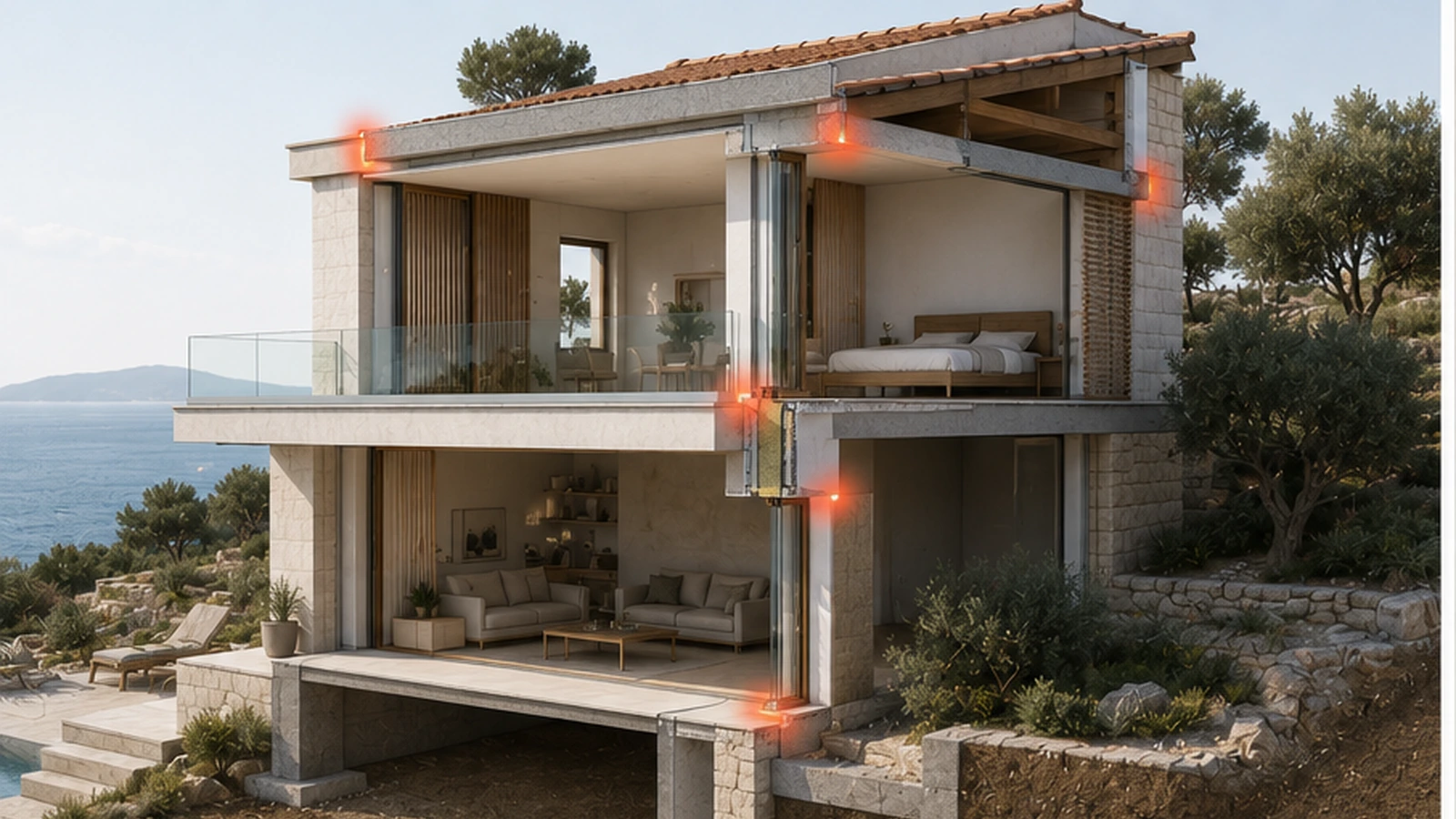
We knew how far we were pushing the envelope in terms of insulation, airtightness and detailing. We cared about thermal bridges, carefully designed junctions, high-quality windows and doors. But cheap energy kills motivation: true efficiency was often perceived as a nice bonus rather than a necessity.
When energy prices rose and reality changed
A few years later, everything began to shift. Energy prices started to rise. For the first time, many of our clients sat down with a calculator and seriously compared different scenarios.
Some of them realised that the cost of project documentation and connection to gas was actually higher than the cost of heating our houses with electricity for five years. This very simple comparison was a turning point.
For us as a team, it was a powerful moment of validation. All those years of:
– obsessing over thermal bridges and insulation levels,
– carefully detailing envelopes and junctions,
– working on airtightness,
– explaining our approach at construction fairs,
– arguing with contractors about “invisible” details,suddenly started to make obvious financial sense for our clients as well. What had previously been an “ideological” choice now became a very practical one.
We felt this shift very clearly at construction expos. When energy became more expensive, our booth was constantly full. There were days when nine members of our team stood at the stand, talking non-stop, explaining energy efficiency, showing details and calculations.
By the evening, everyone had lost their voice. But for the first time, people were not just looking at renderings or facades – they were truly interested in what was hidden inside the walls and how the building would behave years later.
And then the war began.
Bucha: a month without heating in winter
One of the houses we had built was located in Bucha. It was a fully electric house: no gas, no fireplace, no backup boiler – all comfort depended on electricity. For us, it was another high-performance, all-electric project. For the family living there, it was simply their home.
When the full-scale invasion started, that area lost power. No electricity, no heating, no internet, no mobile connection. It was winter. There was snow outside. The blackout lasted for about a month.
For that entire month, we heard nothing from the owners. We did not know if they had stayed or left, if they were safe or not. Like many people at that time, we were watching the news, worrying about our clients, our colleagues, our friends – and we simply had no information.
Then, one day, the owner finally managed to call us.
He did not call to complain.
He called to say thank you.
Here is what happened inside that house, in numbers.
Before the blackout, the family kept the indoor temperature at about 23°C – a comfortable level for everyday life. When the power was cut, neighbouring “normal” houses, built to typical standards, cooled down very quickly.
Within just a few days, temperatures in those houses fell to around +8°C inside. Without heating, their walls, floors and roofs could not hold the warmth for long.
In our house, the behaviour was completely different. The temperature dropped from 23°C to 21°C over the first week without any heating at all. Then, over the following weeks, it slowly moved towards 18°C. During the whole month, the indoor temperature never went below 16°C.
A family lived through a full winter month, under blackout, in a house that stayed between 16–18°C inside without any source of heat.
For comparison, some members of our team are now living in the UK, where +18°C is considered a normal “heated” indoor temperature in many homes. In Bucha, that same level of comfort was maintained for most of the month without any active heating at all.
For that family, the performance of the building was no longer about saving money on bills. It was about not freezing when the entire energy system around them collapsed. It was about having time to survive, to adapt, to make decisions – supported by the thermal stability of their home.
Closing thoughts: resilience, responsibility and why we still push for efficiency
For us as a team, that phone call became the most important feedback we have ever received about our work. It was not about aesthetics, design awards or glossy photographs. It was about resilience, safety and human life.
It also confirmed something we care about deeply on a personal level:
It is extremely important for us to spend our lives doing work we will not be ashamed of in front of our future grandchildren.
When we imagine explaining our work to them one day, we do not want to talk only about beautiful facades or trendy interiors. We want to be able to say that we helped build homes that kept people safe and warm, even in the worst situations. Homes that gave families time and protection when everything around them was unstable.
Since that moment, we have completely stopped thinking of energy-efficient, passive-level envelopes as “a nice extra if you can afford it”. For us, they are a fundamental part of responsible architecture and construction.
A well-insulated, airtight, thermally massive house:
– buys you time in a crisis,
– keeps your family comfortable and safe for longer,
– and can turn “no heating for a month in winter” from a potential disaster into something survivable.
For our team, this is no longer a theoretical concept. It is a lived reality, confirmed by a client’s voice on the phone after a month in the dark, in winter, in a passive-level house we designed and built.
This is why, wherever we work now – whether it is Ukraine, the UK, Spain, Portugal or any other country – we continue to push for energy-efficient, resilient buildings. Not because it sounds good in marketing, but because we have seen what it really means when everything else fails.